BASANT PANCHMI ~ Saturday,
31st January 2009.
Parkash Utsav of Sri Satguru Ram Singh Ji Maharaj.
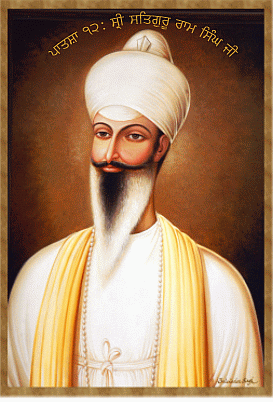 Sri
Satguru Ram Singh Ji was in the line of great spiritual leaders of the world,
but he vivified his spiritualism with action and sacrifice. After the downfall
of the Sikh Government, when utter demoralization had set in among the Sikhs,
Sri Satguru Ram Singh Ji re-kindled into them the spirit of Guru Nanak and Guru
Gobind Singh and chalked out a programme of action to train them in the mission
which the Gurus had come to fulfill.
Sri
Satguru Ram Singh Ji was in the line of great spiritual leaders of the world,
but he vivified his spiritualism with action and sacrifice. After the downfall
of the Sikh Government, when utter demoralization had set in among the Sikhs,
Sri Satguru Ram Singh Ji re-kindled into them the spirit of Guru Nanak and Guru
Gobind Singh and chalked out a programme of action to train them in the mission
which the Gurus had come to fulfill.
Twenty five kilometers from
Ludhiana is located a small village of Sri Bhaini Sahib which embodied a rural
life typical in the land of the five rivers. Around its fields, there existed a
corporate life led by simple, God-fearing and innocent people. In Such a village
was born the great Guru of the Namdhari Sikhs in the year 1816. This was the day
when the fields were green with the crops and the yellow flowers were dancing
majestically from the stems of the plants. Like many other great souls and
Saints, Guru Ram Singh had a pious mother who reared him up by singing to him
the verses from the Holy Granth, and by narrating to him the lives and
adventures of the Gurus and other Epic heroes.
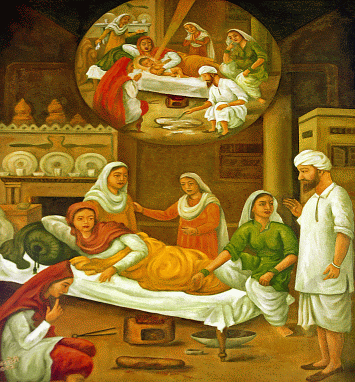 Jassa Singh the father of Guru
Ram Singh held a key position in the village and was greatly respected. Guru Ram
Singh grew up in such a house. He learnt Gurmukhi from his mother and he
memorized many parts of the 'Bani.'
Jassa Singh the father of Guru
Ram Singh held a key position in the village and was greatly respected. Guru Ram
Singh grew up in such a house. He learnt Gurmukhi from his mother and he
memorized many parts of the 'Bani.'
At the age of 9yrs Guru Ram
Singh began to help his father in many works. While the other boys sang the
village folk songs, this promising child always sang verses from the Granth. The
others felt amused, then felt interested, and finally joined the
religious-minded Guru Ram Singh in reciting the holy Verses.
When the Sikhs were getting
ready to start for the battle of Mudki in 1903 (Bikarmi) He was asked to pray
for success. He stood for sometime facing the sun in a mood of ecstasy and
declared. "Pray or do not pray the Sikhs are not going to win". The
Prophecy proved true. When the Sikhs were about to fight at Mudki, Sri Satguru
Ram Singh Ji threw his gun into the river (sutluj), and said that he had thrown
it then, and others would throw theirs later on.
These were the days of his
political education. He saw before his eyes, how the English were advancing
towards the Lahore State and encircling it from all sides: sowing seeds of
dissension, promoting treason amongst the ranks of the Khalsa: and trying to
fulfill their long-cherished ambition. He saw the internal weakness of his
community as well as the external danger from the imperialists. Service in the
army failed to extinguish the religious flame in his heart; he remained regular
in his prayers, forthright in his dealings and elevated in his character. It was
while serving in this regiment that he came under the influence of Guru Balak
Singh. It is believed by the Namdhari Sikhs that the Guru ship was conferred by
the Tenth Gum on Gum Balak Singh of Huzro who passed it on to Guru Ram Singh.
This ended his Military career. He returns to Bhaini Sahib to began to devote
himself entirely to his people and his own religion.
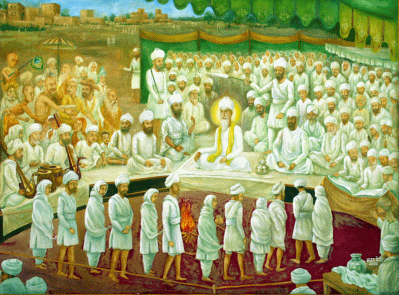 The Namdhari Sikhs known as
Kookas in the political annals of India are rightly called '' Torch bearers of
India's freedom struggle''. Sri Satguru Ram Singh Ji the master planner
of the freedom movement of India, founded the Namdhari Sikh Sect (also known as
the Sant Khalsa) on the eve of the Baisakhi Festival - 1st Baisakh Samat 1914
(12th April 1857) in Sri Bhaini Sahib, district Ludhiana, Punjab. On this day
Sri Satguru Ram Singh Ji re-initiated the Amrit ceremony and rekindled the flame
of Sikhism. The first triangular white flag of the Indian Independence Movement,
which symbolizes Sikh Tenets: Truth, Purity, Simplicity, Peace and Unity was
hoisted by the 12th Sikh Guru, when Sri Satguru Ji re-inaugurated the Sant
Khalsa. Sri Satguru Ram Singh Ji mobilized the people for the freedom of
their country and against the evil customs of society as well. He inoculated
religious awareness among the people to evoke a feeling of self-respect and
sacrifice for the sake of the country. In a short period hundred of thousands of
people flocked to him and became fully aware of their oppression and bondage by
the foreign rulers.
The Namdhari Sikhs known as
Kookas in the political annals of India are rightly called '' Torch bearers of
India's freedom struggle''. Sri Satguru Ram Singh Ji the master planner
of the freedom movement of India, founded the Namdhari Sikh Sect (also known as
the Sant Khalsa) on the eve of the Baisakhi Festival - 1st Baisakh Samat 1914
(12th April 1857) in Sri Bhaini Sahib, district Ludhiana, Punjab. On this day
Sri Satguru Ram Singh Ji re-initiated the Amrit ceremony and rekindled the flame
of Sikhism. The first triangular white flag of the Indian Independence Movement,
which symbolizes Sikh Tenets: Truth, Purity, Simplicity, Peace and Unity was
hoisted by the 12th Sikh Guru, when Sri Satguru Ji re-inaugurated the Sant
Khalsa. Sri Satguru Ram Singh Ji mobilized the people for the freedom of
their country and against the evil customs of society as well. He inoculated
religious awareness among the people to evoke a feeling of self-respect and
sacrifice for the sake of the country. In a short period hundred of thousands of
people flocked to him and became fully aware of their oppression and bondage by
the foreign rulers.
Sri
Satguru Ram Singh Ji laid emphasis to provide
equal status to women in society, education to both girls and boys and help the
people introduce a new expense-free, dowry less, inter-caste mass marriage
system called the ''Anand Karaj''. The first-ever inter-caste marriage was
performed on June 3, 1863, in Khote village of Ferozepore in Punjab. The
Anand form of marriage remained a dead-letter until Sri Satguru Ji advocated
it. The first Marriage performed according to the Anand Marriage maryada
was that of Bhai Samund Singh's daughter at Haripur (Khote). District Ferozpur.
Sri Satguru Ram Singh ji made every effort to accord respect and equal status to
women in society. He took the initiative in extending Sikh Baptism to women
- It is a historical fact that in 1858, Satguru Ram
Singh Ji was the initiator of the Amrit Ceremony to be performed for the
women-folk, thus giving them equal rights and standing without any
discrimination. In June 1863, Guru Ram Singh issued a special
circular in which he prohibited the sale of daughters as well as infanticide.
The circular, according to the official records said: "Whoever makes
money by the marriage of his daughter is a rascal. Whoever commits infanticide
is equally so. Be meek, if any one strikes you even then be meek; your protector
is God. Always hide your good deeds. Look upon the daughters and sisters of the
others as your own."
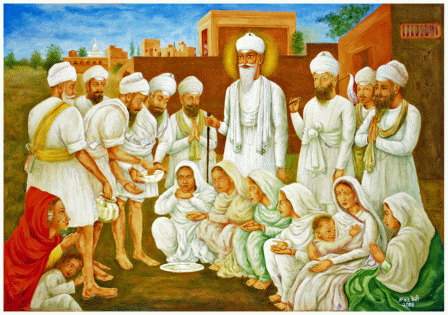
Sri Satguru Ram
Singh Ji, rescued and
restored thousands of web ridden and forgotten copies of Adi Guru Granth Sahib
Ji. From village to village He personally cleaned these Granths and commanded
Sikhs to read, respect and adhere to the hukums written in the Bani.
He mobilized the Sikhs and created over 1,000,000 amrit-dhari Sikhs in
only a few years.
Sri Satguru Ram Singh Ji,
for the first time in world history, used the non-cooperation swadeshi method of
resistance as a weapon to free his country from the yoke of the British Empire.
He ordered the Indian people to boycott the British government’s service,
their educational institutions, their law-courts, and foreign made goods. He
asked them to refuse to obey and resist the laws & orders of the imperial
rulers. In short his message was Be Indian, Buy Indian and Remain Indian.
Sri Satguru Ram Singh Ji
set up his own postal system and a panchayati system to resolve feuds and
quarrels. Diplomatic relations were established with native states and
neighboring countries including Nepal, Afghanistan and Russia. In 1869-70 a
separate regiment called the Kooka Platoon was created in Kashmir. All these
were signs that the Namdharis had established a parallel government. The British
rulers wanted to crush the kuka revolution. On official orders Namdhari Sikhs
were hanged to death in Raikot, Amritsar and Ludhiana. On 17-18 January 1872,
sixty-five kuka revolutionists were blown off with cannons and a boy of 12 years
(name Bishan Singh) was hacked to pieces in Malerkotla, Punjab.
Sri Satguru Ram Singh Ji
was arrested without charge and exiled to Mynamar (Burma) from Ludhiana railway
station on 18 January 1872. All his prominent missionaries (subas) were arrested
and deported to various jails around the country. Namdhari Sikhs were ordered by
the British not hold meeting or gatherings and they could not leave their
residence without informing the police or village head. Hundreds were jailed or
deported to Andaman Islands and their properties seized. But the kookas were
undaunted by this brutal treatment and prosecution by the police. They carried
on fighting for the freedom of India under the design and inspiring guidance of Sri
Satguru Hari Singh Ji & Sri Satguru Pratap Singh Ji. On account of these
pioneering efforts & sacrifices of Namdhari Sikhs and all other patriotic
forces, India attained independence on 15th August, 1947.
Finally in December of 2008,
after some 60 years of struggle, the Government of India recognized the Kuka
Freedom movement and acknowledged that Sat Guru Ram Singh Ji was the architect
of the first freedom movement for the independence of India. Years later Mahatma
Gandhi, Nelson Mandela and many others adopted the non-cooperation methods to
further the fight against the oppressive rulers.
On the 194th anniversary of the
birth of Sri Satguru Ram Singh Ji, we salute the achievements of the 12th
Guru of the Sikhs.....
